
PTBD (Percutaneous Transhepatic Biliary Drainage): An Expert Guide for Patients and Families
When bile cannot flow normally from the liver into the intestine, it backs up—causing jaundice (yellow eyes/skin), itching, dark urine, pale stools, and sometimes serious infection (cholangitis/sepsis). In many such cases, doctors need to urgently decompress the blocked bile ducts.
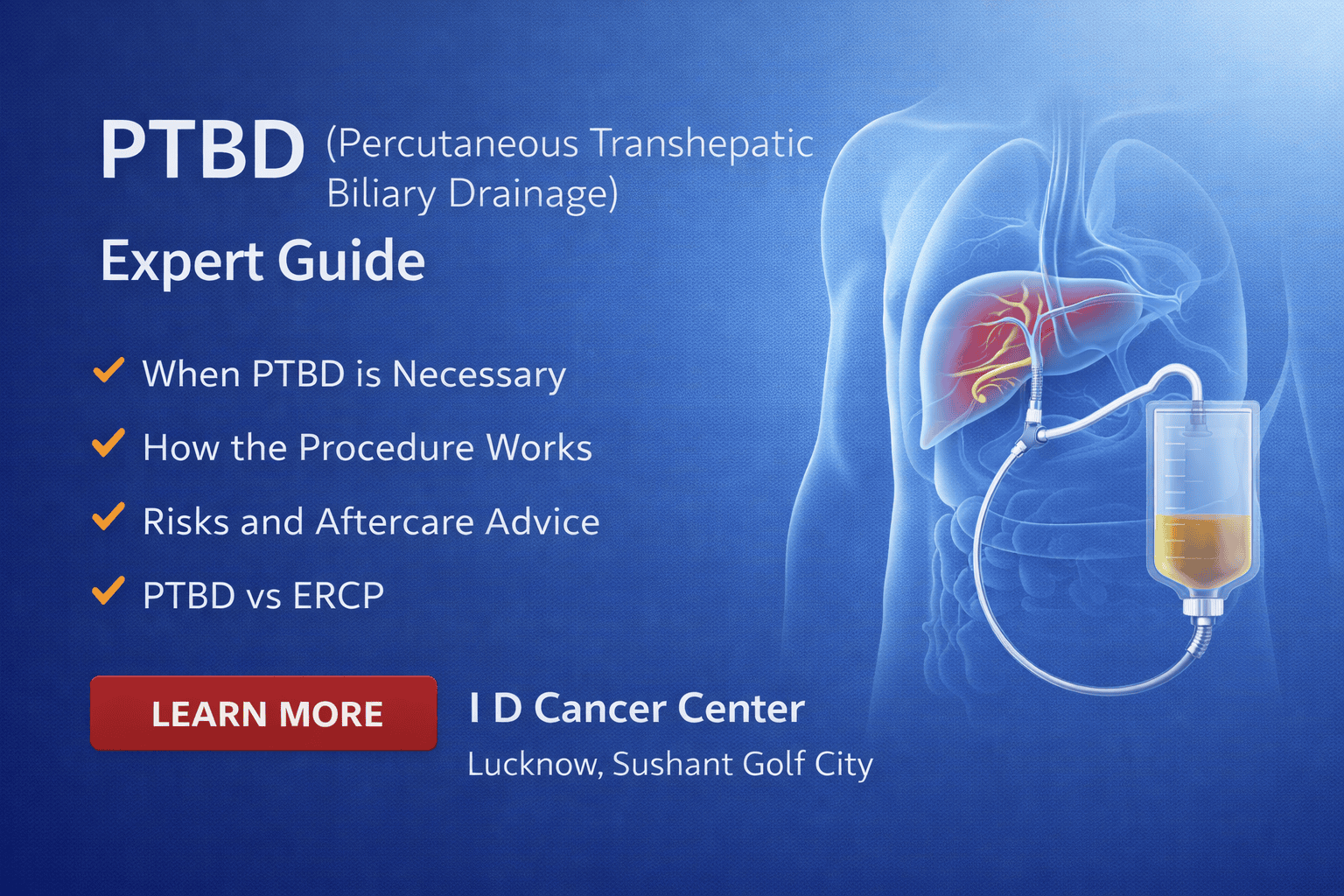
PTBD (Percutaneous Transhepatic Biliary Drainage) is a minimally invasive, image-guided procedure done by an Interventional Radiology team to drain bile by placing a thin tube (catheter) through the skin, into the liver bile ducts. It can be life-saving in infection and can also enable further treatments like surgery, chemotherapy, or stent placement.
What exactly is PTBD?
PTBD is performed under ultrasound + fluoroscopy (X-ray guidance). A radiologist accesses a small bile duct in the liver through a needle puncture, then places a catheter to drain bile:
Types of drainage
External drainage: bile drains into a bag outside the body.
Internal–external drainage: the catheter crosses the blockage so bile can drain into the intestine and optionally outside.
PTBD with stenting: sometimes a metal or plastic stent is placed to keep the duct open and reduce dependency on an external bag.
When is PTBD needed?
PTBD is typically considered when bile duct obstruction must be relieved and endoscopic drainage (ERCP) is not possible or has failed, or when anatomy makes endoscopy difficult.
Common indications (practical list)
Malignant obstructive jaundice (e.g., pancreatic cancer, cholangiocarcinoma, gallbladder cancer with biliary obstruction)
Acute cholangitis (blocked ducts + infection) needing urgent decompression
Failed ERCP or ERCP not feasible (post-surgery altered anatomy)
Benign biliary strictures
Postoperative bile leak (after biliary/HPB surgery)
Selected cases for access to further biliary interventions (stone management, stricture dilatation, etc.)
PTBD vs ERCP: what’s the difference?
ERCP is done via the mouth and stomach into the bile duct (endoscopic route).
PTBD accesses the ducts through the skin and liver (percutaneous route).
In many hospitals, ERCP is tried first when feasible. PTBD becomes the key option when endoscopy fails, is not available urgently, or cannot reach the obstruction.
How PTBD is done (step-by-step)
While exact steps vary, a typical workflow includes:
Pre-procedure assessment
Blood tests for hemoglobin, platelets, INR/clotting
Review of infections, antibiotics, allergies, kidney function
Review of blood thinners and other medicines
Fasting instructions (commonly a few hours)
During the procedure
Local anesthesia + sedation/analgesia as required
Needle access into a bile duct under ultrasound/fluoroscopy
Contrast injection to map ducts (cholangiography)
Catheter placement for external or internal–external drainage
Sometimes balloon dilatation and/or stent placement
After the procedure
Observation and monitoring (pain, vitals, drain output, fever)
Often overnight admission depending on condition and complexity
What benefits should you expect?
PTBD can:
rapidly reduce pressure in blocked ducts
improve jaundice-related symptoms (itching, appetite, nausea)
help control infection in cholangitis
enable further cancer treatment (e.g., chemotherapy) when bilirubin is high
serve as a bridge to surgery or definitive stenting
Risks and complications (expert but patient-friendly)
PTBD is generally effective, but it is still an invasive procedure. Main risks include:
1) Infection (cholangitis/sepsis)
Because the biliary system can be infected or can become infected after instrumentation, antibiotics are often used, especially when cholangitis is suspected.
2) Bleeding (hemobilia or internal bleeding)
Bleeding can occur due to injury to blood vessels in the liver. Reviews describe significant bleeding rates that vary across studies, with many large series around ~2–2.5% for significant bleeding.
3) Bile leak
Leak of bile into the abdomen can cause pain or peritonitis and may require further management.
4) Pain and fever
Mild pain at the puncture site and transient fever can occur.
5) Rare chest complications
Depending on approach (especially high right-sided puncture), pleural complications like pneumothorax/effusion are uncommon but recognized.
Your treating team balances these risks against the risk of untreated obstruction/infection, which can be more dangerous.
Living with a PTBD drain: practical aftercare
Some patients go home with a drain for days to weeks; in some cases, longer-term drainage may be needed, especially in malignant obstruction.
Core home-care principles
Keep the dressing clean and dry; follow the IR/nursing instructions.
Do not kink the tube; keep the drainage bag below the level of the liver.
Record drain output if instructed.
Attend scheduled follow-ups for tube check, exchange, or stent planning.
Red flags: seek urgent medical help if you develop
Fever/rigors, worsening jaundice, confusion (possible infection/sepsis)
Increasing abdominal pain, distension, vomiting
Fresh bleeding from the tube, black/tarry stools, dizziness/fainting (possible bleeding)
Tube dislodgement, sudden stoppage of output with pain/fever
Increasing redness/pus at the skin entry site
When can the drain be removed?
Drain removal depends on the underlying problem and the next-step plan:
If a stent is placed and functioning well, the external catheter may be removed sooner.
If it’s a temporary bridge (infection control, surgery planning), it may stay for a shorter period.
If obstruction is unresectable, some patients may need longer-term drainage with periodic tube changes.
PTBD in cancer care: why it’s often part of the plan
In oncology, PTBD is frequently used to:
relieve malignant obstructive jaundice
stabilize the patient so systemic therapy can start safely
palliate symptoms (itching, cholangitis) and improve quality of life
Take-home message
PTBD is a safe, established, minimally invasive option to drain blocked bile ducts.
It is often used when ERCP is not possible/failed, or when urgent decompression is needed.
Aftercare and early recognition of red flags (fever, bleeding, severe pain) are crucial.
I D Cancer Center
If you have obstructive jaundice, cholangitis symptoms (fever + chills + jaundice), or a biliary obstruction related to cancer, we can coordinate an urgent evaluation and streamline referral to an experienced Interventional Radiology team for PTBD/stenting when indicated.
