MRCP: The Best Non-Invasive Scan for Bile Duct & Pancreatic Duct Problems
When someone has jaundice (yellow eyes/skin), upper-abdominal pain, fever with chills, pancreatitis, abnormal liver tests, or suspicion of a blocked bile duct, the key clinical question is simple:
Is there an obstruction, where is it, and what’s causing it (stone, stricture, tumor, inflammation)?
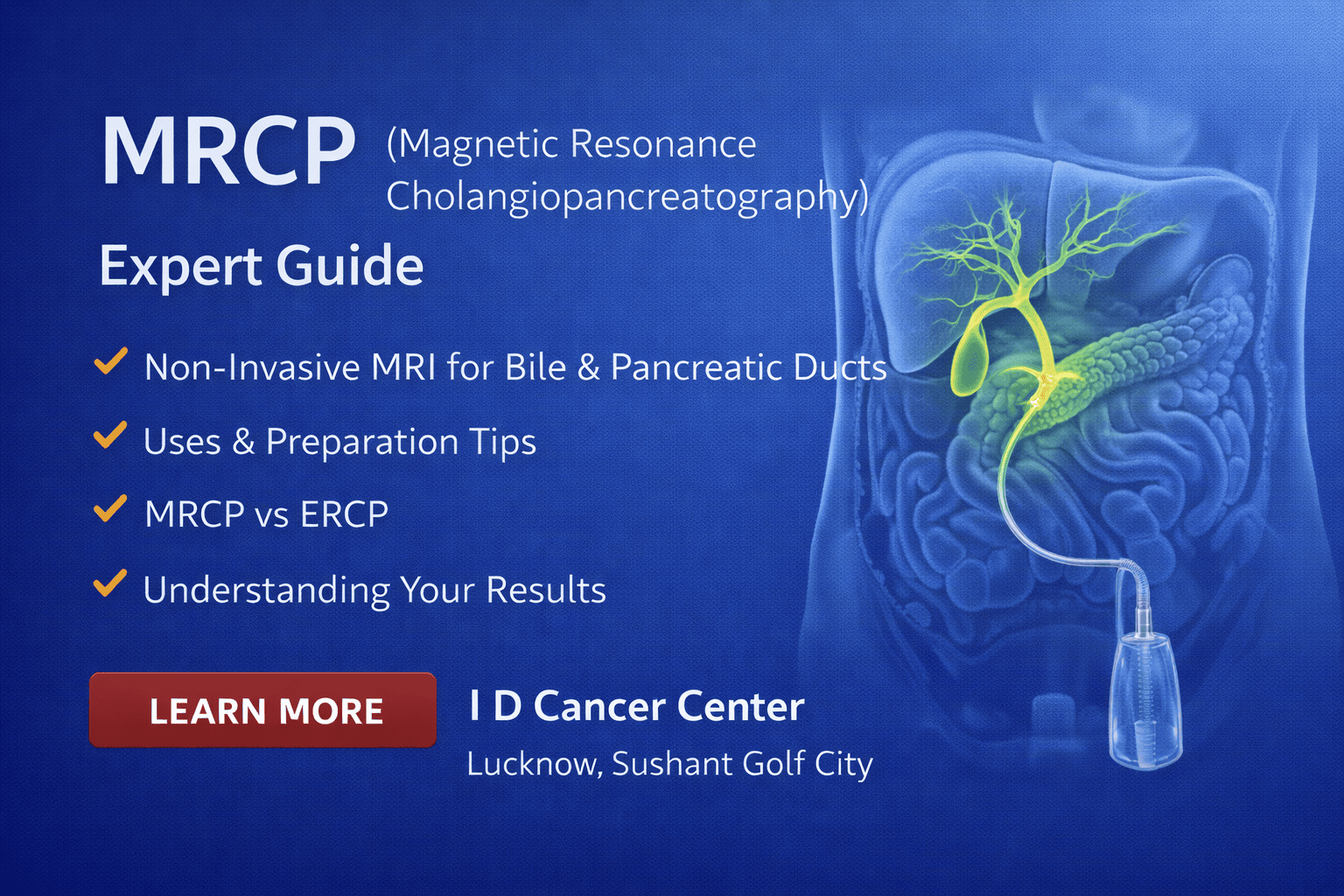
MRCP (Magnetic Resonance Cholangiopancreatography) is a special MRI technique designed to produce detailed images of the bile ducts, gallbladder, and pancreatic duct—without using an endoscope. It is one of the most valuable, low-risk tests to map the biliary tree before deciding whether a therapeutic procedure (like ERCP or surgery) is needed.
What is MRCP?
MRCP is an MRI-based imaging method that uses heavily fluid-sensitive sequences to make bile and pancreatic duct fluid appear bright, allowing radiologists to see:
Bile duct dilatation (suggesting blockage)
Common bile duct stones (choledocholithiasis)
Biliary strictures (benign or malignant)
Pancreatic duct abnormalities
Patterns suggestive of diseases like primary sclerosing cholangitis (PSC)
It is typically performed as:
MRCP alone, or
MRI abdomen + MRCP, where the radiologist evaluates the liver, pancreas, gallbladder, and surrounding tissues along with ducts.
When do doctors recommend MRCP?
MRCP is especially useful when we suspect problems such as:
1) Obstructive jaundice
MRCP helps determine whether jaundice is due to mechanical obstruction and can show the level and likely cause(stone vs stricture vs mass).
2) Suspected bile duct stones
In patients with intermediate probability of bile duct stones, guidelines support MRCP or EUS before proceeding to ERCP—because ERCP carries procedure-related risks and should be used primarily when therapy is likely needed.
3) Recurrent pancreatitis / suspected pancreatic duct obstruction
MRCP can evaluate ductal anatomy and detect strictures or stones and may be paired with a full pancreatic MRI when clinically indicated.
4) Suspected biliary stricture or cholangitis pathway planning
MRCP provides a roadmap for the duct system—helpful when planning ERCP, PTBD, surgery, or oncology treatment sequencing.
MRCP vs Ultrasound vs CT vs ERCP (clear comparison)
Ultrasound (USG)
Usually the first test for jaundice or RUQ pain.
Good for gallstones and duct dilatation, but may miss the exact cause/level in many cases.
CT scan
Useful for masses, complications, or staging; not always best for duct detail.
MRCP (MRI)
Best non-invasive duct mapping.
Strong for stones/strictures/duct anatomy.
No endoscope; no “instrumentation” of ducts.
ERCP
Not just a test—primarily a treatment:
stone removal
stent placement
sphincterotomy
Has higher complication risk than purely imaging tests, so it’s ideally reserved when intervention is likely needed.
How to prepare for MRCP (this matters)
Preparation protocols vary slightly by center, but common essentials include:
1) Fasting
Most centers ask you to fast for several hours to improve gallbladder/biliary visualization and reduce bowel motion artifacts. (Follow your MRI unit’s instructions exactly.)
2) MRI safety screening (metal/implants)
MRI uses a strong magnetic field. You must inform the team about:
pacemakers/defibrillators
aneurysm clips
cochlear implants
metal fragments (especially in eye)
- neurostimulators and certain older devicesSome implants are MRI-conditional; the radiology team will verify compatibility.
3) Kidney function and contrast (if contrast is planned)
MRCP itself often does not require contrast, but if combined with contrast MRI (to evaluate liver/pancreas lesions), gadolinium may be used. Kidney function matters mainly when contrast is planned.
What happens during the scan?
Typical experience:
You lie on the MRI table; coils placed over abdomen.
The scan runs multiple sequences; you may be asked to hold your breath briefly.
Total time often ranges 20–45 minutes depending on protocol.
The test is painless; the scanner can be noisy (ear protection provided).
If you have claustrophobia, inform the team—many centers can support with reassurance, music/communication, or mild medication when appropriate.
What can MRCP detect?
MRCP is commonly used to identify:
Bile duct stones
Benign strictures (post-surgery, inflammation, pancreatitis-related)
Malignant obstruction (pancreatic head mass, cholangiocarcinoma, gallbladder cancer with biliary obstruction)
PSC-like ductal beading/irregularity (interpreted with clinical context)
Pancreatic duct strictures/dilatation
Anatomic variants (important for surgery/planning)
It also helps decide the next step: observation, medical therapy, ERCP, PTBD, surgery, or oncology planning.
Limitations (important to understand)
MRCP is excellent, but not perfect:
Small stones or subtle strictures can sometimes be missed depending on image quality and patient factors.
Motion (breathing), bowel gas, or poor fasting can reduce clarity.
MRI is not possible for some unsafe implants or certain patient conditions.
After the scan: what next?
Your report typically answers:
Are ducts dilated?
Is there a stone? Where?
Is there a stricture? Benign vs suspicious pattern?
Is there a mass or secondary signs suggesting malignancy?
Recommended next steps (e.g., ERCP for therapy, EUS, oncology referral, follow-up imaging)
If there is a treatable obstruction, the next step is often ERCP (stone removal/stent) or PTBD if ERCP is not feasible—based on anatomy, urgency, and local expertise.
MRCP in cancer care (why oncology teams rely on it)
In suspected pancreaticobiliary cancers, MRCP helps:
map obstruction level and duct anatomy
guide biliary decompression planning
- support staging planning when paired with contrast MRI sequencesThis improves treatment readiness, especially when jaundice is delaying systemic therapy.
FAQs
Is MRCP safe?
For most patients, yes—MRI is widely used and non-invasive, with the main safety focus being implants/metal screening and kidney function if contrast is planned.
Is MRCP painful?
No—there’s no scope insertion. Discomfort is mainly from lying still and the enclosed scanner space.
MRCP or ERCP: which is better?
They are different tools:
MRCP = diagnosis/roadmap
ERCP = treatment (when intervention is expected)
I D Cancer Center: When should you consult us?
Please seek evaluation if you have:
jaundice with itching, dark urine, pale stools
fever with chills + jaundice (possible cholangitis)
recurrent pancreatitis
persistent upper abdominal pain with abnormal LFTs
